As remodeling businesses grow, operational complexity increases.
More crews, more services, greater marketing investment, tighter sales accountability, multi-location oversight.
The systems that supported your business at $3M or $5M may not support it at $15M or $30M.
This isn’t a failure of the platform. It’s a matter of stage alignment.
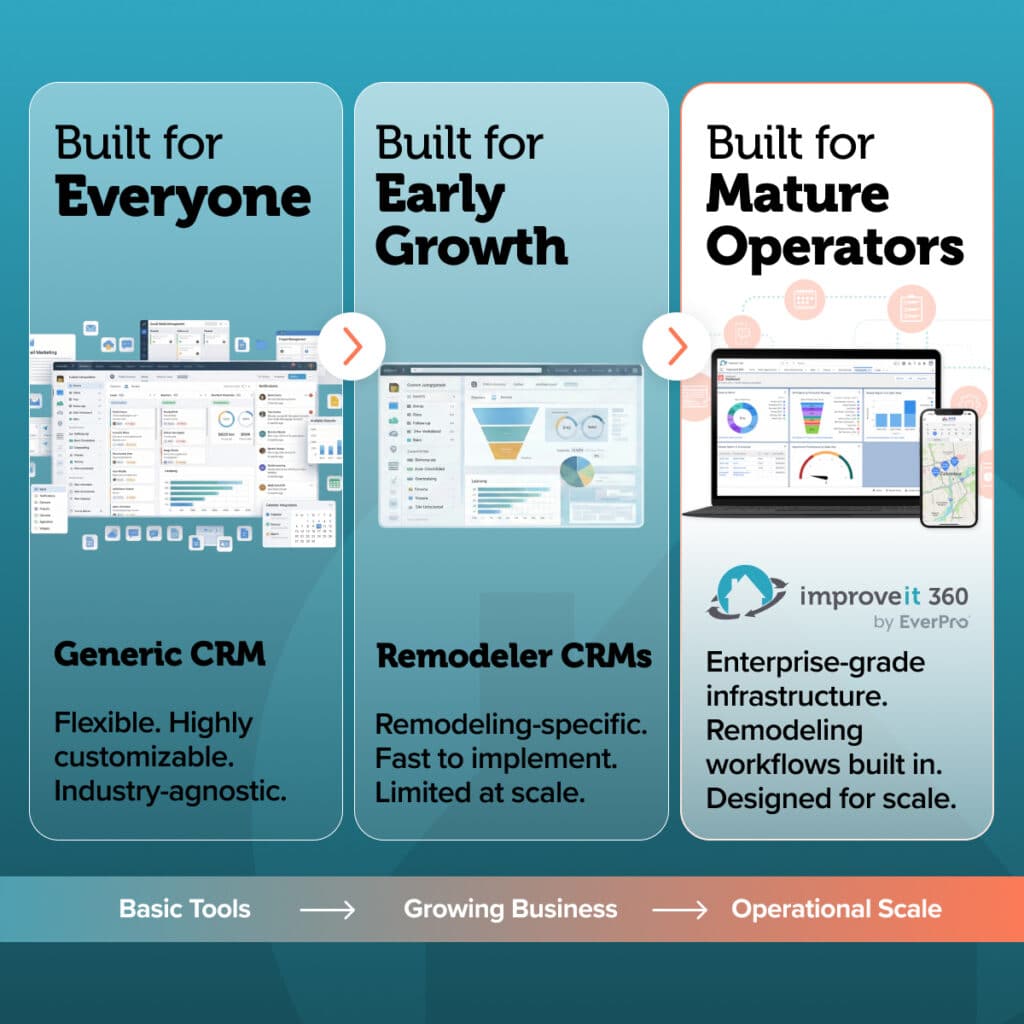
Most CRM platforms used in the remodeling industry fall into three broad categories. Each serves a purpose. Each fits a different level of operational maturity. Understanding which category you’re operating in can clarify whether your system is supporting growth – or quietly creating friction.
Category 1: Generic, Industry-Agnostic Platforms
Built for Everyone
Platforms in this category are designed to serve many industries. They offer flexibility and broad functionality, but usually require deep customization.
Common examples include enterprise CRMs such as Salesforce or HubSpot.
Strengths
- Flexibility
- Integrations
- Enterprise-grade infrastructure
Limitations for Remodelers
- Begin as a blank slate
- Require significant customization to reflect remodeling workflows
- Often demand internal admin resources
- Reporting and job flow must be built from scratch
For organizations with internal CRM teams, this model can work. For specialty remodelers without that infrastructure, it can become an ongoing rebuild effort that sucks time and money away from the business.
Category 2: Purpose-Built, Out-of-the-Box Remodeler CRMs
Built for Simplicity
These platforms are designed specifically for home improvement businesses. They are typically fast to implement and effective for core sales and lead management functions.
Examples in the market include MarketSharp, LeadPerfection, Buildertrend, and Jobber.
Strengths
- Remodeling-specific workflows
- Faster implementation
- Lower complexity
Limitations at Scale
- Reporting depth can plateau
- Limited flexibility as operations expand
- Multi-location oversight may be constrained
- Workflow customization can become restrictive
- Integration limitations
These tools often work well in early growth stages. As businesses mature and complexity increases, limitations may begin to surface.
Category 3: Enterprise Infrastructure Configured for Mature Remodelers
Built for Scale
This category combines enterprise-grade architecture with workflows designed specifically for specialty remodeling operations.
Rather than starting as a blank slate – or limiting flexibility for simplicity – these platforms are built to support operational maturity.
Designed For
- Service-level profitability tracking
- Structured sales-to-production alignment
- Executive-level reporting
- Scalable automation
- Multi-crew, multi-location visibility
- Integrations across various business operating tools
At this stage, your CRM is no longer just a sales system. It becomes operational infrastructure.
It enables:
- Real-time performance visibility
- Structured job flow management
- Capacity planning and forecasting
- Expansion without rebuilding core systems
- Clear oversight across locations
This is the segment improveit 360 was built to serve.
Choosing the Right CRM Category for Your Business Stage
The key question isn’t whether your CRM works, it’s whether it aligns with the stage your business is operating in – and the stage you’re growing into. What worked at $5M may create friction at $20M. What feels manageable at $20M may strain under expansion. That’s why it’s so important to choose the right CRM for where your business is today—and where it’s going next.
- In a narrow, reputation-driven industry, operational clarity matters. Systems that require workarounds compound friction over time. Systems designed for scale reduce it.
As your business evolves, your infrastructure should evolve with it.
If you’re unsure whether your current CRM fits your stage of growth, it may be time to evaluate your options. A 20-minute strategic review can help pressure-test your tools against what other mature remodelers are doing.